Manna
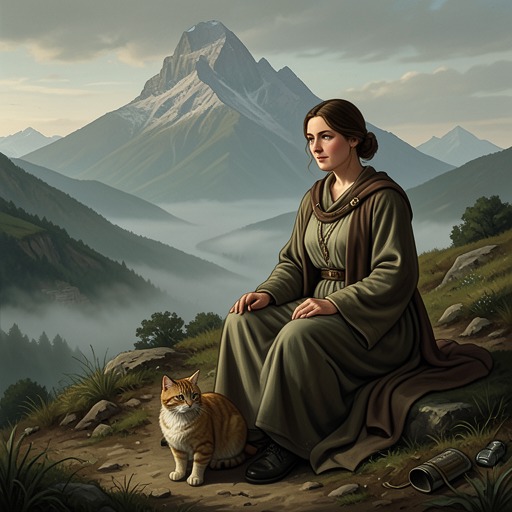
5 Centimeters per SecondManna is a young girl in Agartha whose mixed parentage makes her existence a matter of communal suspicion and deliberate testing. The granddaughter of an Agarthan elder and daughter of a Topsider, she is also closely associated with Mimi: the cat leads Ryuuji Morisaki to Asuna Watase, later stays perched on Manna, and is mourned by Manna when she dies. Manna’s story turns on the contrast between the village’s judgment of her as a test case and the tender, concrete acts of welcome and mourning that surround her.
Identity and Background
The village elder identifies Manna as his granddaughter and welcomes her back when she returns with Asuna Watase and Ryuuji Morisaki. He lifts her into his arms and tells her, “Manna, I’m glad you came back.” His words establish both their family relationship and the significance of her return to him.
Manna’s father is a Topsider. The elder describes her as an admixture, a rare result of a union between people of the surface and Agartha. In the elder’s account, the Izoku hate admixtures, making Manna’s parentage a point of danger in a world governed by forces that resist such mixing. The narrative gives no further account of her parents or of how she came to be separated from her grandfather.
The Test and Her Return
Morisaki recognizes the implication of the elder’s explanation: Manna had been intentionally left somewhere the Izoku would appear. He says that the people responsible wanted to see whether she would make it home safely, and whether the world would allow her to exist. The elder neither confirms nor denies the accusation; instead, he tells the visitors to come with him. His refusal to answer leaves the test’s organizers unstated, but the circumstances make clear that Manna’s safety was made to serve as a trial of her belonging.
When the villagers withdraw behind a wall and Asuna and Morisaki approach the riders, the small girl jumps down from a horse and runs happily toward them. The men murmur among themselves, beyond Asuna’s hearing. The elder then steps forward, gathers Manna into his arms, and asks the visitors to forgive the village’s discourtesy and allow him to thank the people who saved his granddaughter. Her joyful movement toward the group contrasts with the suspicion surrounding her identity: she returns not as an argument about whether she belongs, but as a child welcomed into her grandfather’s embrace.
Manna and Mimi
Mimi’s connection to Manna first appears through the cat’s actions. After Asuna wakes on a riverbank, wet and disoriented, Morisaki says that she owes her escape to the little animal; when Asuna asks who he means, he explains that Mimi led him to her. Later, when Asuna prepares to leave, Mimi is sitting on Manna’s head. Asuna calls for the cat to come along, but Mimi only meows and does not move. The elder suggests that Mimi may have fulfilled her role, while the scene itself leaves the bond between girl and cat visible in their physical closeness and the cat’s refusal to leave.
After Mimi dies, Manna sobs as the elder looks after her, holding Mimi’s still body in her hands. The elder tells her to weep freely, then takes Manna and Shin outside the village to a broad plain. There he points to a solitary stone pedestal. Manna runs to it and gently lays Mimi’s body on the stone. Her grief is given time and a place: rather than being hurried past, it leads into a quiet act of care for the dead cat.
Narrative Significance
Manna’s episodes bring two forms of vulnerability into close relation. Her mixed parentage exposes her to a test in which others make her safety stand for the world’s willingness to accept her; Mimi, meanwhile, helps guide the living and is eventually mourned as her own journey ends. Manna’s return and her farewell to Mimi are not presented as equivalent events, but both are shaped by the elder’s care and by gestures of physical tenderness. The girl who was treated as a question about whether she could exist is also shown running toward home, being held by her grandfather, and laying her companion to rest.